Accelerating Digital Transformation in Agriculture
Author: Sander Janssen
Publish Date: 11 October 2021
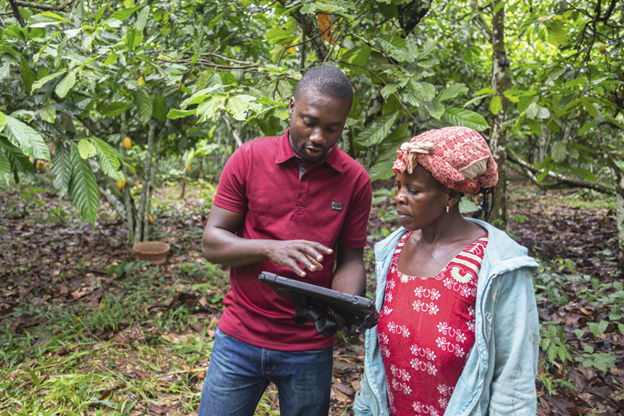
Digital technologies have strong potential to support the transformation of agriculture, building a resilient, sustainable and inclusive agrifood system [1]. As key enablers, digital innovations can play a catalytic role – especially in the wake of COVID-19 – by improving the capacity of small-scale producers (SSPs) to adapt to external shocks and increasing productivity and profitability. With more than 33 million smallholder farmers and pastoralists [2] already registered on such platforms, sub-Saharan Africa alone has seen a rapid increase in the adoption of digital solutions, recording an annual growth of 44 per cent over the three-year period ending in 2018. Despite a rapid expansion of the digitalisation for agriculture (D4Ag) sector across low-and-middle income countries, the reach and sustainable use of D4Ag solutions remains fairly low, especially among SSPs. Only 13 per cent of smallholders in sub-Saharan Africa are registered for any digital service and far fewer are actively using such services [3]. Inadequate access to the Internet and digital services, coupled with issues of affordability, disability and a growing digital divide, are among factors that have widened the disconnect. One of the main barriers holding back investment in D4Ag solutions and their impact at scale is lack of cost-effective ways of comparing and contrasting solutions, and making informed decisions on which ones will really work.
Promoting alliances and investments
Despite a highly complex and fragmented digital sector, there is significant potential for establishing sustainable partnerships and investments. For this reason, there is a growing need for greater coordination of D4Ag solutions and their overarching ecosystem, but how best to achieve this?
Stewart Collis from the Bill & Melinda Gates Foundation (BMGF), says that Digital Agri Hub (the Hub) can play an important role in driving D4Ag solutions for small-scale producers: “Evidence suggests bundled digital farmer services positively impact small-scale producers’ livelihoods by improving access to inputs, information on managing crops and livestock, obtaining climate mitigating finance and insurance and accessing markets. Digital Agri Hub will collate the essential data necessary to understand which combinations of services are reaching men and women small-scale producers at scale with impact, and act as a guide for investment and adoption of the most impactful digital agriculture products, solutions and services.”
Josh Woodard from The United States Agency for International Development (USAID) adds: "As the number of digital solutions in the agricultural sector continues to grow, the Digital Agri Hub will allow practitioners to make more informed decisions and bring clarity to a fragmented information landscape. We're excited by the potential for greater impact as a result of a more cohesive digital agriculture space."
Convinced of the scope for digital technologies in the agriculture sector, FCDO, BMGF and the United States Agency for International Development (USAID) are co-funding the Hub to monitor and track the development of digital for agriculture solutions, and their impact in helping to achieve a climate-resilient, sustainable and inclusive food system. Responding to the direct needs of the diverse stakeholder groups that play an active role in D4Ag will be an important focus for the Hub. To this end, it has conducted a needs assessment, with the aim of identifying, unpacking and addressing the major needs for each of the different actors on the pathway towards the sustainable growth of the sector.

The emerging issues
Across the nine identified stakeholder groups, made up of donors, (impact) investors, D4Ag solution providers, agri-food value chain actors, agritech companies, innovation repositories, policy makers and direct implementers (farmers’ organizations and non-governmental organisations), a broad range of issues has emerged. Tomaso Ceccarelli, the lead coordinator on this Ecosystem coordination activity from the Digital Agri Hub team, observes that: “Stakeholders have different perspectives and goals. But there is one trait that unites most of them, and this is the need for a structured overview on initiatives and reliable insights on the impact of D4Ag.”
Gigi Gatti from Grameen Foundation USA – one of the Digital Agri Hub partners – says that: “It is essential to work with existing D4Ag networks and Communities of Practice to understand how to best connect them to the Hub.”
Responding to these diverse needs is a key success parameter for
the Hub, integrating such crucial and different perspectives in its
programme of work. Simona Benvenuti from the Netherlands
Advisory Board on Impact Investing (NAB) – a Digital Agri Hub
partner – experiences that "to accelerate the
mobilization of private-sector capital into D4Ag it is critical to
provide impact-based data on existing D4Ag solutions and insights to
mitigate investment risk, thus facilitating collaboration amongst
the different types of capital providers and knowledge exchange
globally across the value chain".
Daniele Tricarico, from GSMA, also a Digital Agri Hub
partner, has closely assessed the development of the D4Ag
sector and worked with a number of different solution providers in
collaboration with mobile operators. From his perspective,
"it is exciting to see a growing number of D4AG services
coming to market, but this fast-paced sector also experiences a high
level of fragmentation and many short-lived initiatives. It is
therefore crucial to quickly identify emerging best practices and
highlight the operational and business models that can support truly
sustainable, scalable solutions".
Inclusion for all stands out as a critical prerequisite for the sustainable development of D4Ag. In support, Eunice Likoko, from Wageningen University and Research (WUR), adds that: “For women and marginalised groups, improved access to D4Ag solutions will be stimulated by understanding and addressing the barriers they face in accessing digital solutions. Intervention strategies need to go beyond minimal participation of excluded groups, to adopt more empowering approaches that address underlying barriers to promote sustainable and realistic adoption of digital solutions for these groups’’.
A hub for inclusive agricultural transformation
To ensure the strong and sustainable growth of the D4Ag sector, a better tracking mechanism will be central to the success of Digital Agri Hub, while supporting the everyday decision-making process of D4Ag actors across the agrifood system. Whether the decision is to partner with another D4Ag solution provider, to invest in a D4Ag solution, to create awareness and stimulate the development of the sector in a particular country, or to invest in digital developments for societal impact, access to insights, data and knowledge is crucial. It is Digital Agri Hub’s firm intention to truly act as a hub, bringing partners together, creating capacity and connecting actors to one another, helping them to share their insights and best practices towards inclusive agricultural transformation.
_________________________________________
[1] World
Bank, 2019. Future of Food: Harnessing Digital Technologies to Improve
Food System Outcomes (available here).
[2] 13% of all sub-Saharan African smallholders and pastoralists and
up to 45% of smallholder households, depending on assumptions used to
calculate penetration.
[3] D4Ag solutions refer to the digitally
enabled business models and technologies to address farmers and food
system actors’ constraints (e.g. around market access, inputs,
financing and climate).